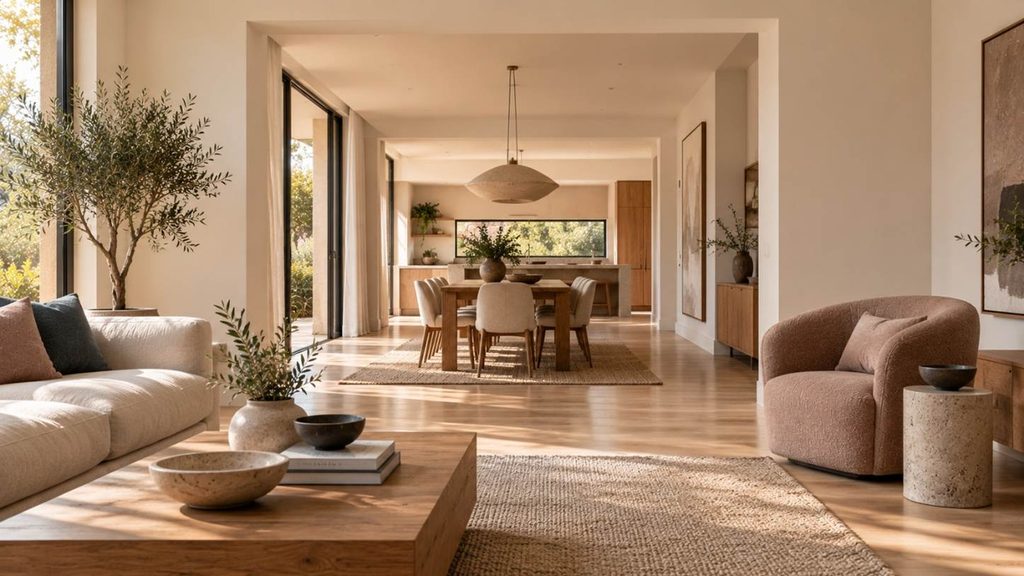
Calm homes aren’t a collection of rooms. They are one story, told room by room.
You feel flow before you notice it. You walk from the entrance to the living area to the kitchen, and nothing jolts.
When flow is missing, each room may look lovely on its own. Together, they feel disconnected. The home never quite settles.
Start with one palette for the whole home
Choose a base palette of three to five colours and let every room draw from it, in different proportions.
The living room might lean towards warm sandstone. The study might go deeper, into blue-grey. Each room has its own mood, but they clearly belong together.
Follow the sightlines
Stand at your front door. What do you see first? Then look through to the next room, and the one beyond it.
Sightlines are the paths your eye travels through a home. Place something worth seeing at the end of each one: an artwork, a window, a sculptural plant, a well-lit console.
A good sightline draws you forward. A blank or cluttered one stops you short.
Repeat materials, with restraint
Repetition creates rhythm. The same timber tone in the dining chairs and the study shelving. One stone repeated in the kitchen and a bathroom vanity. A single metal finish carried across handles and light fittings.
The key is restraint. Two or three materials, repeated well, do more than ten used once.
Keep flooring continuous where you can
Changes in flooring break a space into parts. Where possible, run the same floor through connected living areas.
Where a change is needed, make it at a natural threshold such as a doorway, rather than in the middle of an open space.
Treat transitions as part of the design
Passages, doorways and stair landings are where flow is made or lost. Keep them clear. Light them well.
Think of each doorway as a frame for the room beyond. What it frames matters.
Let furniture guide movement
- Allow around 900mm for main walkways so movement feels easy.
- Float furniture off the walls where space allows. It creates natural paths through a room.
- Align rugs and furniture with the architecture: windows, fireplaces and openings.
A simple test
Walk slowly through your home, starting at the front door. Notice where you pause, or where something feels abrupt.
That is usually where a colour, material or object is working against the rest.
Flow isn’t about everything matching. It’s about everything belonging.
I share more on how we plan homes that feel connected on Instagram at @kpd.designstudio. Where does your home feel most disconnected?