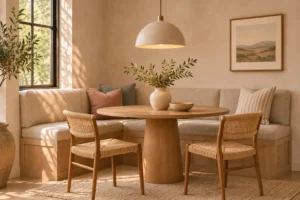
Every room has a corner it forgot about.
Often, it’s the first place your eye lands when you walk in. Your gaze moves naturally to the far edges of a room, and if what it finds there is an empty angle, a stray plant or a stack of things with nowhere else to go, the whole space feels slightly unfinished.
When we design a room, corners get the same attention as the sofa wall. Not because they need filling, but because they need a reason.
Why corners matter
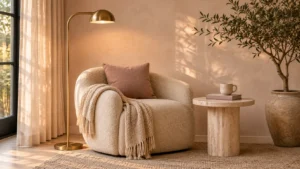
Corners hold the edges of a room together. They shape sightlines, frame windows and define how large a space feels.
A neglected corner reads as unresolved. An overfilled one reads as clutter. The goal sits between the two: a corner that looks considered, and earns its place by being used.
Start with light
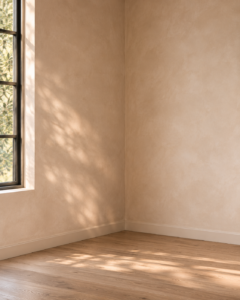
If you only do one thing, light the corner.
Most rooms are lit from the centre, which flattens them in the evening. A floor lamp or a wall light in a corner pulls the edges of the room in, adds depth and makes a large room feel more intimate after dark.
Choose warm light, set low. A linen shade or a soft glow behind a chair creates the kind of quiet pool of light people naturally drift towards.
Give it a reason
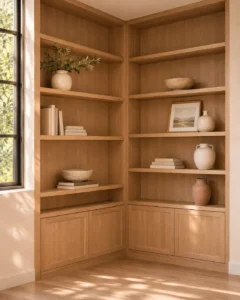
Once the corner has light, give it a purpose. Function first, styling second.
- A chair and a side table make a reading corner.
- A small desk turns an unused bedroom corner into somewhere to write.
- Built-in shelving gives a home to books and one or two meaningful pieces.
Think about how you actually live. A reading chair in a house where no one reads will always look staged. A writing desk where you pay bills every Sunday will look like it belongs.
Soften the geometry
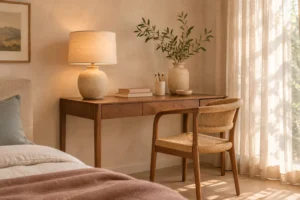
Two walls meeting at ninety degrees is a hard line. The best corners soften it.
A curved chair, a round side table or a tree in a stone pot breaks the angle and lets the corner feel relaxed rather than boxed in. Natural textures help too: bouclé, linen, timber, woven cane.
Built-in corner solutions
Some corners are better solved by the architecture than by furniture.
A built-in banquette turns a kitchen corner into the place the family gathers for breakfast. Corner shelving uses space that freestanding furniture never could. In the kitchen itself, well-planned corner storage turns the most awkward cupboard into one of the most useful.
These solutions take more planning, but they are often what makes a home feel thoughtfully designed rather than simply furnished.
What to avoid
Filling for the sake of filling. A corner doesn’t need something in it just because it’s empty.
The lonely plant. A single pot pushed into a corner with nothing around it often makes the space feel more forgotten, not less.
Too many layers. One or two well-chosen pieces are enough. Then stop.
A considered corner makes the whole room feel finished.
|
For more design decisions, explained, follow me on Instagram at @kpd.designstudio. |